

Breeding low-emitting sheep
The Cool-Sheep breeding programme enables New Zealand sheep breeders to measure and rank animals in their flocks so they can prioritise breeding stock that are naturally low methane emitting.
Current projects
| Project title | Lead organisation/s |
|---|---|
|
Breeding low-emitting ruminants |
Bioeconomy Science Institute |
Background
Research into the potential to breed for low methane-emitting traits in sheep has been underway in New Zealand since 2007, initially funded by PGgRc and MPI’s Sustainable Land Management and Climate Change (SLMACC) fund and subsequently by the AgEC. This work established that some sheep naturally emit less methane per kilogram of food eaten than others.
In 2012, flocks of low- and high-emitting sheep were established by measuring the methane emissions and daily feed intakes of over 1,300 animals. Since then, research has confirmed a genetic basis for the variation in methane emissions between animals, meaning the reduced-emission trait is passed on from generation to generation.
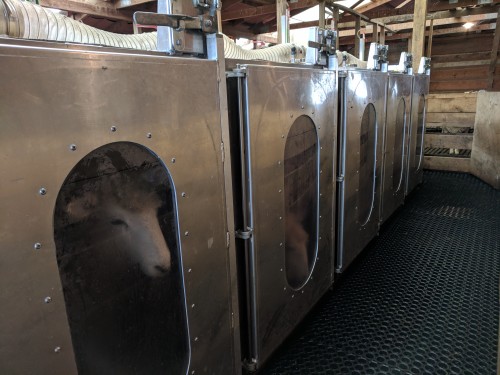
Sheep having their methane emissions measured in the Portable Accumulation Chambers
Progress
To date, five generations of selection has resulted in the selection lines differing by close to 25% in their methane emissions.
Researchers have monitored the selection lines for growth, reproduction and other performance parameters. There is no evidence that important production traits, such as growth rates, wool production and disease resistance, are compromised in the low-emitting line. In fact, preliminary economic analysis shows that low-emitting sheep could lead to higher profits, primarily due to higher growth rates, a greater proportion of meat, and increased wool production.
At the farm level, Portable Accumulation Chambers (PAC) enable farmers to measure methane emissions from individual animals and identify low emitters for breeding purposes.
Ongoing Investment and Research
The breeding programme (also known as Cool-Sheep) is unique in the world, and in 2019 research breeding values for low methane emissions were made available to selected ram breeders through Beef + Lamb Genetics. This is a major step forward, with researchers predicting that a 1% decrease in methane emissions per year is potentially achievable. Research using the selection lines is ongoing and continues to confirm positive results for the low-emitting line in terms of animal reproduction, productivity and health. The resulting dataset is one of the most comprehensive in the world and provides a unique resource to study the associations between rumen microbial composition, methane emissions, circulating volatile fatty acids in the blood and detailed fatty acid profiles in milk.
In April 2026, the Cool-Sheep programme received an additional $1.2 million in funding to enable the research to continue. This further funding is a joint investment by the AgEC, AgriZeroNZ, Beef + Lamb New Zealand, and MPI.
The additional funding extends the programme for another year and enables further research to strengthen the accuracy of the breeding value for methane.
It will also explore:
-
Feed efficiency implications of selection for methane emissions using animals from the contrasting selection lines, with results expected later this year.
-
Measurement of methane emissions and collection of genetic information from 5000 sheep to strengthen the accuracy of the breeding value.
This initiative aims to support farmer uptake of low emissions breeding by giving farmers confidence that they can reduce emissions without compromising productivity and feed efficiency and by collecting more farm-based data to strengthen the evidence supporting the breeding approach to methane mitigation.
Learnings from this research is also being applied to other ruminant livestock systems. including dairy cattle.

