

New Zealand Agriculture & Climate Change Conference 2026
Published: June 3, 2026
Unlocking Our Low Emissions Advantage
Global food markets are evolving. Low-emissions production is emerging not just as a sustainability requirement, but as a defining marker of quality, resilience, and long-term value.
The 2026 Agriculture and Climate Change Conference was brought to you by the Ag Emissions Centre in partnership with AgriZero and MPI. The event brought together international market leaders, policymakers, rural professionals, scientists, and farmers to examine what these changes mean for New Zealand and how the country can respond strategically.
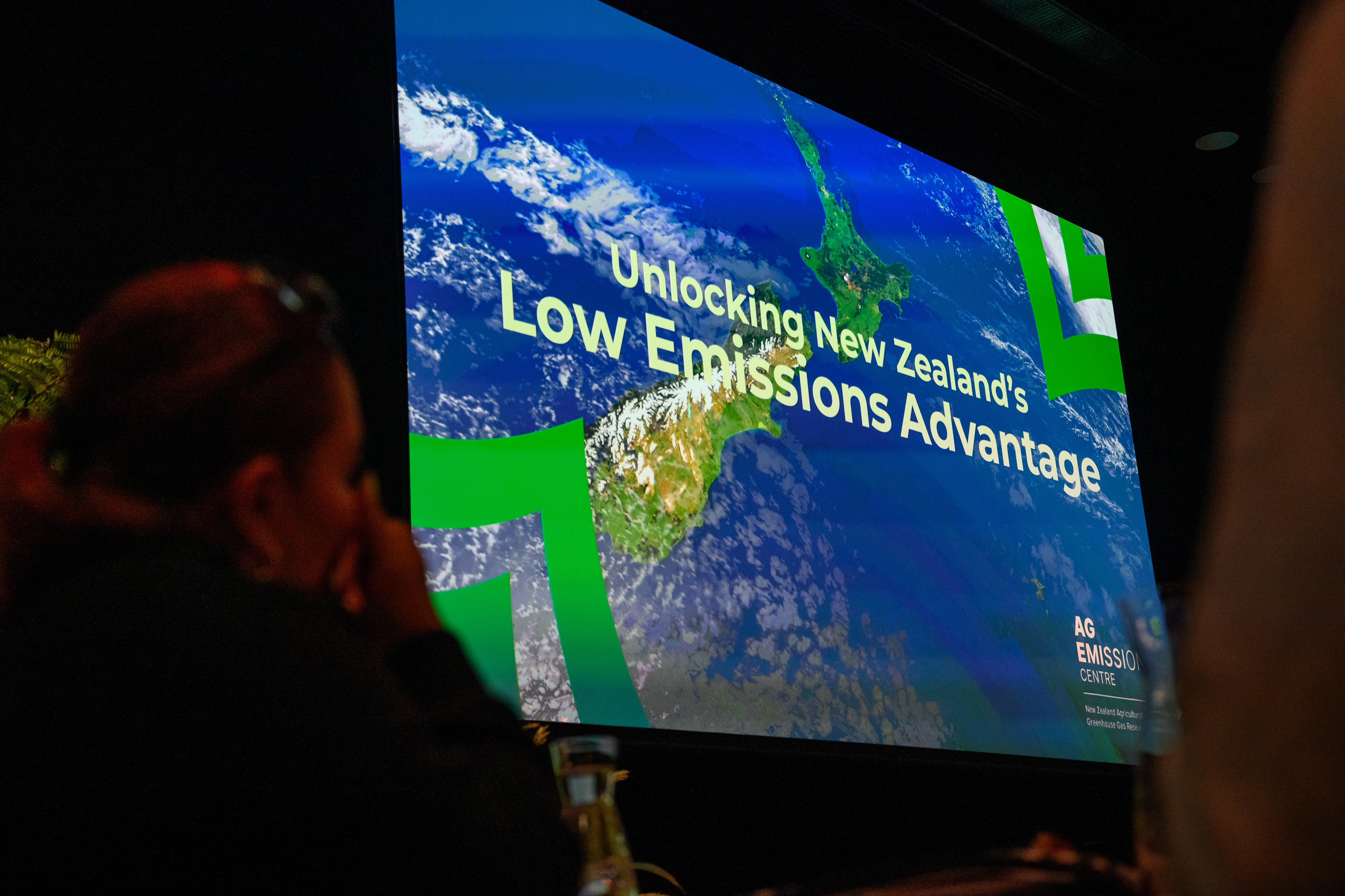
The 2026 New Zealand Agriculture & Climate Change Conference was held 29th-30th April 2026 at Tākina, Wellington, New Zealand.
- Disclaimer: Certain presentations have been removed from this conference recording to respect privacy and confidentiality requirements. As a result, the content shown here may differ slightly from the original live event.
Mihi Whakatau, Welcome, Setting The Scene: The Economic Environment and Ministerial Address
He mihi nui ki Te Āti Awa for the mihi whakatau and karakia that grounded the start of the day, and the opening of the conference. A meaningful reminder of the importance of connection and unity as we come together to tackle shared challenges.
Naomi Parker Ag Emissions Centre, welcomed a full plenary and our Emcee, Eloise Gibson, set the tone for the next two days focusing on both global and national context and practical pathways forward. A key theme emerging early, New Zealand is facing turbulent and volatile times, with increasing geopolitical and climatic uncertainty. However, our small export-focussed nation has a proven ability to adapt at scale and a long history of farming well. Now is the time to stay ahead of the curve, to work together across science, industry and policy, and to lead with what we already do well – but better.
Global Market Signals
A full house for our Global Market Signals sessions, and for good reason. The conversation made one thing clear, that this could - and should - be New Zealand's time to shine. However, we need to continue to evolve and to make a choice to lead rather than follow.
In the first session we heard global perspectives from China, the United States, and Australia, on how each country is approaching reducing their emissions from both policy and science angles. It was great to hear that, although NZ may be small, other nations are looking to learn from – and work with - us in this space. They fully expect our research and approach to this challenge to have broadly applicable global impacts - and we need to keep up the good work!
The second session unpacked further perspectives from those that deal directly with international markets and customers. The talks included information about buyer signals, double materiality, Scope 3 reporting, and how producers are working together with their customers to ensure secure future-fit supply chains.
Key takeaway? Market forces, from customers to competitors to capital, are aligning to accelerate the transition. It may sometimes appear that sustainability has taken a back seat, however it remains a long-term trend that we cannot afford to ignore.
For New Zealand’s primary sector, this presents a clear direction of travel: those who can measure, manage, and reduce emissions, will be best positioned to capture future value.
Low-Emissions Agriculture Research: International Insights
Shifting from global signals to action that’s closer to the farm gate, the last sessions of Day 1 focused on what low-emissions agriculture looks like in practice, both internationally and in New Zealand. Our ‘Low-Emissions Agriculture Research: International Insights’ session highlighted the progress and challenges, turning innovation into impact.
Australia: A strong example of collaboration at scale, with the Zero Net Emissions Agriculture CRC model demonstrating how coordinated research and industry partnerships can accelerate change.
Denmark: Insights into deploying low-emissions technologies, focusing on the Bovaer story, showed both the potential wins and the real-world challenges of on-farm adoption. An acute reminder that progress requires both innovation and practical implementation.
Leading at Home: How NZ Farmers are Responding to Low-Emissions Demand
Sharpening focus closer to home, our final session of the day chaired by Carla Muller Perrin Ag, explored how three different NZ farming entities have embedded a range of sustainability and low-emissions actions throughout their operations.
The panel discussion highlighted how different strategies were applicable to different farm types, and that farmers do not think about emissions reductions in isolation. Building on shared values could help to increase adoption of new practices and tools in the future, as “Ka ora te whenua, ka ora te tangata; When the land is well, we are well.”
Leadership and Resilience in a Changing World
Attendees were left with an inspiring talk from Alexander Hillary Himalayan Trust, reiterating that rural resilience is part of our national culture and that, when facing hard things, “not possible” has never been the Kiwi way. Addressing climate change is this century’s big challenge and every step, every action, every connection counts. Plus, making positive change can also be exciting if we allow it to be.
Welcome to Day 2 and The Role of Tools and Technology to Unlock Our Low-Emissions Advantage
Onto day two of the New Zealand Agriculture & Climate Change Conference and the focus has shifted to a critical question: What tools are in the pipeline, what is the science behind them and how do we ensure that they are adopted?
Opening the morning, Hayden Montgomery Global Methane Hub, outlined the critical role of coordinated, sustained science investment in delivering the vision ahead. We then heard an Irish perspective from John Roche MPI, covering the range of research in progress in Ireland, and the importance of connecting scientists with farmers to ensure practical application at the farm level.
Brendan O’Connell AgriTech NZ, encouraged us to see the full picture and think at a systems level. He reminded us that “the tool is the lever; the farmer is the force.” Plus, whilst New Zealand has a higher percentage of ‘trail-blazers’ than the norm, with new technologies the gap between ‘available’ and ‘adopted’ is closed by human and commercial conditions – not by better tools. Melissa Clark-Reynolds also challenged attendees to think widely, across whole supply chains and emerging technologies in other sectors. She pointed out that “the present is messy and contradictory and the future will be too.” However, we need to pay attention to the signals now to ensure that NZ is well placed to farm and produce food well into the future.
Portfolio Overview, Updates and Accelerations
Naomi Parker Ag Emissions Centre, shared the latest on NZ’s agricultural emissions research, showcasing real momentum across methane tools and technologies. Wayne McNee AgriZeroNZ, continued by detailing the focus on accelerating pace, and how we move innovations out of the lab and into farmers’ hands faster.
We also heard directly from six speakers representing different elements of New Zealand’s R&D portfolio: Lewis Frost Nbryo, Andrew Leech Bovotica, John Caradus Grasslanz, Jacob Bubolz Zoetis, Richard Spelman LIC and Sinead Leahy Ag Emissions Centre. Talks included information about low-methane genetics (and how this may be able to be accelerated), probiotics, inhibitors, nitrous oxide reducing forages, and large fundamental trials demonstrating the breadth of investment and innovation underway.
Key Technology Updates, and Emissions & Profitability in Practice
The afternoon started with George Reeves Ruminant Biotech, providing an update on their methane reducing bolus which is anticipated to launch later this year. Elliot Mercer Agnition, then covered EcoPond – a homegrown, NZ innovation which is available to farmers right now. The EcoPond story demonstrated how potential can be turned into real world action that can make a meaningful impact.
The last speaker of this session, Mark Neal DairyNZ, showed an analysis of NZ farm data which clearly emphasised that high profitability can be found in both high and low-emissions intensity farms. There are opportunities, that can be taken now, to move towards win: win, high profit: low-emission farming systems.
Unlocking New Zealand’s Low-Emissions Advantage and Closing Remarks
The closing panel, facilitated by Scott Champion, brought together voices from across the sector - farmers, governance leaders, Māori agribusiness, and industry - to reflect on why we’re all focussed on this important challenge and where best to direct our efforts going forwards.
Closing out the conference David Hughes provided an excellent overview of the two days and reminded us that we are not alone in our mahi and that we are part of a much larger global effort. Together we can build a future-fit, resilient future that we can be proud to pass on to the next generations.
Published: June 3, 2026

